









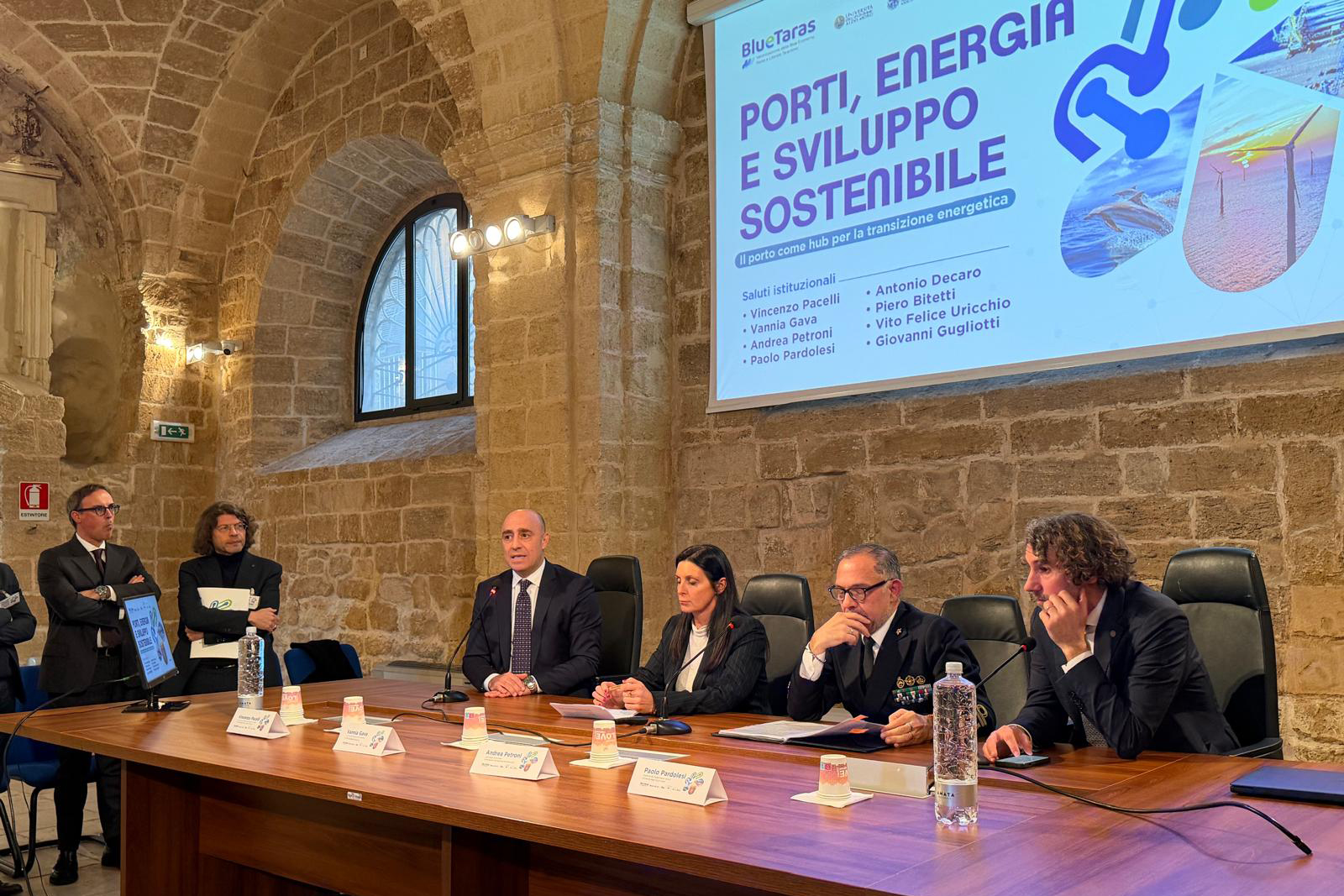
TARANTO, 31 JANUARY 2026 - Taranto is positioning itself not only as an energy hub, but as a genuine hub of change, capable of leading the ecological, industrial and employment transition in Southern Italy. This was the clear message that emerged from the conference “Ports, Energy and Sustainable Development”, held on 30 and 31 January at the Ionian Department of the University of Bari “Aldo Moro”.
The event was organised by the University of Bari Aldo Moro and the Ionian Sea Port System Authority as part of the Blue Taras project, with the support of sponsoring bodies, including the City of Taranto. Two days of discussions between institutions, the academic world, businesses and industry stakeholders highlighted how the port of Taranto, thanks to its infrastructure, industrial and strategic characteristics, can play a key role in decarbonisation, the development of renewable energy - particularly offshore wind power - and the sustainable regeneration of the region. The port of Taranto stands to benefit from a major transformative opportunity: to become the national hub for offshore wind. Taranto has, in fact, proved to be a strategic hub for the environment, energy and employment. Yet, to facilitate its development, we need multi-level governance, flexible regulations and a forward-looking vision to turn legacy issues into opportunities.
In this context, Vannia Gava, Deputy Minister for the Environment and Energy Security, reiterated the Government’s support for the transformation of the port and the city: “The government intends to respond to the local community: we will restore the areas that have been damaged over the years. Port activities”, the Deputy Minister continued, “are the driving force behind growth, and the port of Taranto is a strategic hub for industrial regeneration, which also means the creation of new jobs. Taranto, for example, is one of the ports in Italy suitable for hosting offshore wind farms. We believe in sustainable development to boost the economy whilst safeguarding public health and the local environment: that is why we have allocated funding to Taranto, as well as introducing legislation to streamline key procedures. The government wants to provide the funding, but above all it wants to put people and businesses in a position to spend it, so that all projects can be implemented as quickly as possible. The challenge in the immediate future is to safeguard Italian ports, including the port of Taranto, in order to prevent traffic from being diverted to other ports.”
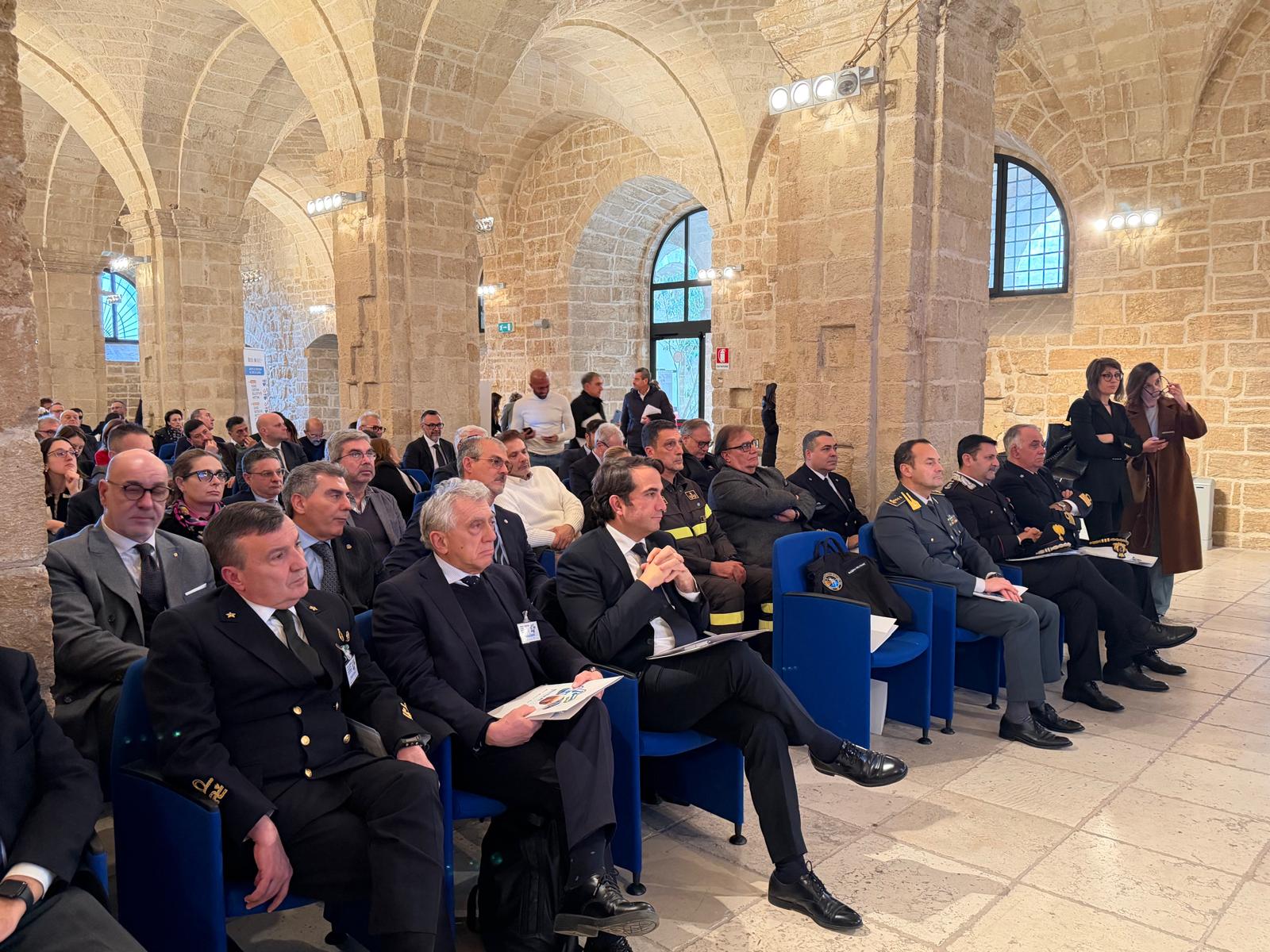
On the first day, following the official welcome by Vincenzo Pacelli (UniBa), Vannia Gava (Deputy Minister for the Environment and Energy Security), Andrea Petroni (Rear Admiral, Commander of the Southern Maritime Interregional Command), Paolo Pardolesi (Head of the Ionian Department in “Legal and Economic Systems of the Mediterranean: Society, Environment, Cultures”), Piero Bitetti (Mayor of Taranto), Vito Felice Uricchio (Extraordinary Commissioner for urgent remediation, environmental restoration and regeneration in Taranto), and Giovanni Gugliotti (Chairman of the Ionian Sea Port System Authority), the following spoke Stefano Zunarelli (UniBo), Antonio Messeni Petruzzelli (Chairman of Tecnopolo Mediterraneo), Isabelle Ryckbost (Secretary General of ESPO - European Sea Ports Organisation), Donato De Carolis (Rear Admiral (Port Authority), Maritime Director for Puglia and the Ionian coast of Basilicata), Giuseppe Delle Foglie (UniBa), Lara Marchetta (UniBa), Giuseppe Catalano (La Sapienza).
 |
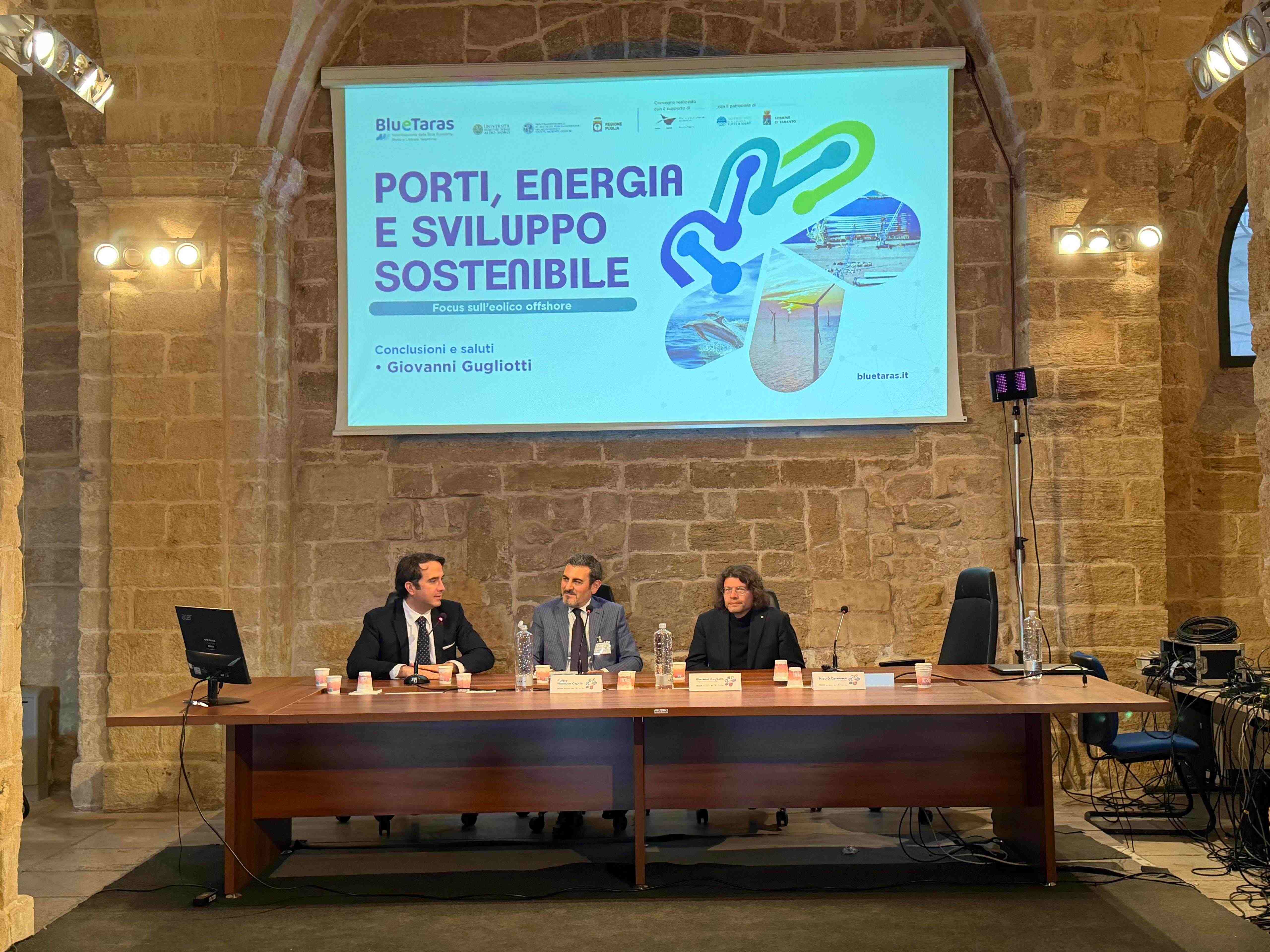 |
On the second day, following the opening remarks by Nicolò Carnimeo (UniBa), Vincenzo Cesareo (Chairman of the Brindisi-Taranto Chamber of Commerce), Salvatore Toma (Chairman of Confindustria Taranto) and Giuseppe Danese (Chairman of Confindustria Brindisi), the following spoke Francesca Pellegrino (University of Messina), Ugo Patroni Griffi (UniBa), Donato De Carolis (Rear Admiral (Port Authority), Maritime Director for Puglia and the Ionian coast of Basilicata), Mariagiulia Previti (lawyer), Roberto Carlucci (UniBa), Jonathan Herno (General manager of Vestas Blades Italia), Francesco Corvace (Department of Economic Development, Puglia Region), Vincenzo Prencipe (Raccomar Puglia), and Enrico Azzarello (Group project manager of Euroports).
“The port as a hub for the energy transition”
The first day of proceedings, focusing on the theme “The port as a hub for the energy transition”, made it possible to outline a clear strategic direction: to speed up the implementation of investments and projects, returning areas in need of regeneration to the local community, and strengthening the role of the Port System Authorities as a driving force for the country’s economic and industrial development. The discussion addressed key issues such as transport infrastructure, the protection of the marine environment, underwater activities, and technological innovation projects relating to defence, security and sustainability. The importance of training and research in marine-related disciplines was also highlighted, along with the need to provide businesses with the space and opportunities to attract and consolidate a new economy in the region. The prospects surrounding hydrogen and alternative fuels have demonstrated how innovation and sustainable development can go hand in hand. The presentations highlighted the potential of the Port of Taranto as a strategic hub for renewable energy, whilst also emphasising the need for a clear and enabling regulatory framework: from the topic of hydrogen and submarine cables for data transmission - with the emblematic case of Marseille - to the flexibility of legal instruments for governing the new roles of ports, right through to issues relating to the allocation of investment decisions and the impacts of the ART resolution on concessions. With regard to Port Renewable Energy Communities, the debate focused on national legislation, the value of the social benefits, and the long-term economic sustainability of PRECs and the associated energy infrastructure.
Development and innovation in offshore wind power
The second day of the conference focused on offshore wind power, one of the most complex and strategic sectors for Italy and, in particular, for Puglia. The port of Taranto, home to the country’s only operational nearshore wind farm, was presented as a case study of European significance, highlighting how an industrial ecosystem has developed around the Ionian port, capable of generating integrated supply chains for the production of wind turbine components and systems. Chaired by Fulvio Mamone Capria, Chairman of AERO (Associazione delle Energie Rinnovabili Offshore - Association of Offshore Renewable Energies), the discussion explored industrial opportunities for the Italian economy and growth prospects for Southern Italy. The presentations provided a comprehensive overview of the key issues facing the sector: from the international and European legal framework governing offshore renewables to the opportunities offered by Exclusive Economic Zones, from the safety of maritime infrastructure to national legislation on offshore wind farms, with particular reference to the complexity of the authorisation processes. Considerable attention was also given to measures to mitigate the impact on the marine ecosystem, to industry experiences - including that of Vestas Blades Italia - and to regional energy planning. The focus has now expanded to include logistics, port operations and industry, ranging from the transport of project cargo for wind power to international benchmarks such as the Port La Nouvelle wind farm, confirming Taranto’s role as a key hub for the Italian port sector.
“The conference ‘Ports, Energy and Sustainable Development’ provided a high-profile forum for discussion on a sector that is crucial to the country’s growth and competitiveness, namely renewable energy”, said Giovanni Gugliotti, Chairman of the Ionian Sea Port System Authority. “The participation of internationally renowned speakers, alongside representatives from institutions, academia and the business sector, ensured a high standard of scientific and practical analysis. At such a crucial stage in the development of the port city of Taranto, the presence of Vannia Gava, Deputy Minister for the Environment and Energy Security, clearly demonstrated the government’s commitment to moving towards the goal of establishing a new model of sustainable development. As the Ionian Sea Port System Authority, we intend to continue supporting this process of dialogue and collaboration, fostering lasting synergies between research, business and local communities, in order to translate the expertise and vision that have emerged into concrete projects that strengthen the role of ports as hubs for energy innovation and sustainable development, for the benefit of the local area and the country as a whole.”
In conclusion, Nicolò Carnimeo (UniBa) argued that “port sustainability can no longer be treated as a set of sector-specific measures or as a requirement imposed from outside. This requires a structural overhaul of the port model and its governance arrangements. Smartness is not merely a technological gimmick, but the very condition that makes sustainability effective, measurable and manageable. Ports are no longer merely places where energy is consumed efficiently; they are becoming active hubs for the production and distribution of renewable energy, playing a full part in the industrial supply chains of the energy transition. It is in this integration of sustainability, smartness and development that the future of European ports lies.”
The conference therefore concludes with a shared vision: the port of Taranto as a strategic infrastructure for energy, innovation and sustainable change, at the heart of a new partnership between institutions, the local area and the business community. These two days do not mark the end of the journey, but rather the start of a shared journey. Taranto has demonstrated that it possesses all the necessary conditions - in terms of infrastructure, science, industry and institutions - to play a leading role in the energy transition in the Mediterranean, as a green, multifunctional and innovative port.